Posts

Showing posts with the label harish

Which station has longest continuous time series of aerosol related observations?

Sometime I wonder are there any questions left which Google can not answer? Today I stumble upon one such question, when I was just curious to know which station is oldest running station for aerosol related observations? I know in Barrow,Alaska and South Pole, CMDL is monitoring AOD since 1977. But don't know whether these are the oldest stations. And what about black carbon, surface size distribution, PM10, scattering coefficient. I guess one can expect to get long-time series for PM10 at least. Let us compile the list. Leave the name of station and time period in comment, you know for aerosol related obs. are being made from the station.

What is Carbon Trading?

Well, this is not exactly the aerosol related post. However, reducing carbon dioxide by incorporating newer technology will have side effect (of cause good) of reducing atmospheric aerosols, after all aerosols and carbon dioxide have more less similar source namely vehicular emissions, coal based power plants, etc. However, million dollar question is how society plans to pursue people and industry for reducing carbon dioxide emissions at global scale. One of the ways, politicians and economist come-up with is carbon trading. What is carbon trading? Can it achieve its stated objective? There are different opinions about it. Let us see one of the opinions in this video. Do you remember movie " Story of the Stuff ", if yes then well this video is from same people. The Story of Cap & Trade from Story of Stuff Project on Vimeo .

Is atmospheric aerosol an aerosol? comments on the article by Jaenicke

Image
The title of a recent article " Is atmospheric aerosol an aerosol? " by Jaenicke caught my attention. This took me back in time, when I was just beginning my career in this field. The first definition I came across or rather assumed was: "anything solid or liquid suspended in the air is aerosol". According to this definition birds and aeroplanes were also aerosols! Thinking of birds and aeroplanes as aerosols wasn't intuitive hence I had to search for a more refined definition. A better one that I came across (well I don't remember from where) was: "any thing suspended in the air and doesn't have self-propelling mechanism is aerosol". This definition implied that mosquitoes are not aerosols but bacteria and virus are. However, this new definition didn't help me win an argument with my friend Neeraj (one of the authors of this blog) who held an opinion that water and ice clouds are aerosols as well, whereas I held the opinion that they are n...

Dust Aerosol: Spherical Vs Non-Spherical

In most climate and radiative transfer models, optical properties of aerosols are modeled using spherical shape assumptions. This assumption is based on sound scientific reasoning. All liquid aerosols have spherical shape because of surface tension. Solid aerosols, which are water soluble also eventually absorbs water vapor from atmosphere and transform themselves into spherical shape. However, dust aerosols are neither liquid nor water soluble. Soot aerosols also fall in this category. Hence, they may not necessarily have spherical shape. This requires that we should examine the validity of spherical shape assumption, particularly for these two types of aerosols. There are two aspects to look at for importance of spherical shape assumption. One is relative magnitude of non-spherical aerosol number concentration. If there are not quite large number of non-spherical particles in the atmosphere, then we need not worry about it. Li and Osada (2007) have shown using model study that dust ...

Conferences in the field of aerosol, cloud and climate

Image
Recently I received quite a good number of conference related notifications. Many of reader of this blog may be participating it and they shouldn't miss the dead-line so I am listing them below. If you know conference that is not listed below but related to theme of this blog please let us know. 15th National Space Science Symposium, India (NSSS-2008) National Space Science Symposium is one the largest gathering of space scientist in India. It covers wide variety of subjects including remote sensing of atmosphere and climate change study. The next NSSS is going to be held at Radio Astronomy Centre (NCRA-TIFR) in Ooty between 26 and 29 February 2008. Ooty is one of the famous hill-station in India. Last date to submit abstract Dec 7, 2007. Broad subject areas covered in this conference Space- and ground-based astronomy and astrophysics, planetary science / exploration Solar radiation and its interaction with earth's near and distant environment Magnetosphere, ionosphere, therm...

History of Aerosol Science

Image
The first time my interest in aerosol science picked up was when I learnt about nuclear winter -- a phenomena which refers to possible climatic impact of all-out nuclear war. What really fascinated me was the idea that if one wants to control climate or weather in predictive manner, aerosols are going to be the best tool; for a reason that they have relatively short life-time giving control over their introduction and removal in the atmosphere. Well! this is not the subject of today's post. Thinking of my own interests in this field led me to think about history of aerosol science. Couple of years before I read Spencer Weart's " The Discovery of Global Warming ". I am fascinated by its content and writing style. Experience was not less than reading suspense thriller. Later on, I come across a comment that book is weighted toward contributions of American scientists than European scientists. I do not know the truth as my knowledge in the history of climate science is l...

International Symposium on Aerosol Chemistry Climate Interactions

My alma mater Physical Research Laboratory , Ahmedabad, India is holding an International Symposium on Aerosol-Chemistry-Climate Interactions Symposium will be from 20-22 November 2007 . Last date to send abstract is 31 August 2007 . The topics covered are 1. Observations of Atmospheric Parameters Measurements of trace gases, aerosols, using in situ and remote sensing techniques 2. Transport and Transformation of Trace Gases and Aerosols Long range and inter-continental transport, and stratosphere-troposphere exchange 3. Modeling of Atmospheric Processes Emission inventories, sinks, model development and evaluation 4. Radiative Forcing and Climate Change Aerosol-cloud interactions, impact on environment and climate 5. Space Instrumentation for Probing the Lower Atmosphere Advances and developments in space techniques, sensor characterization and retrieval algorithms Limited traveling and registration fee support will be provided to young scientists (below 35...

Atmospheric Aerosol and Ultraviolet Radiation

Ultraviolet (UV) radiation plays very important role in bio-geo-chemical cycle. Their harmful effects include skin cancer, cataract, immune suppression, reduction in crop yield, etc. Beneficial effects are synthesis of vitamin D in human body, treatment of psoriasis, etc ( Lucas et al., 2006 ). My interest in UV radiation is how it interacts with atmospheric aerosols. Aerosols are one of the many factors which determines amount of surface reaching UV radiation. While scattering type of aerosols may reduce surface reaching UV radiation, they increase the actinic flux which in turn increases the photolysis rate for smog formation ( Dickerson et al., 1997 ). Relation of aerosol and UV radiation is not one-way; while aerosols affect surface reaching UV radiation, they are affected by surface reaching UV radiation. This is particularly true for naturally produced sulfate aerosol. Recently scientific community has shown a lot of interest to study UV induced sulfate aerosol production to bet...

Cloud Properties Using Zenith Radiance Measurement

Image
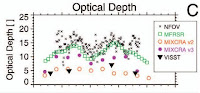
Last Thursday Warren Wiscombe was in my department ( AOSC, Univ of Maryland ) to give a talk. Many of us have greatly benefited from radiative transfer code DISORT. He is a co-author to that code. He has written few other excellent algorithms and code for atmospheric remote sensing. His code for the Mie scattering can be downloaded here . His talk was about deriving cloud properties using ground based zenith radiance measurements. Focus of the talk was cloud optical depth. Cloud optical depth is very important parameter for climate modeling as can be understood from the fact that at any time more than 60% of the earth’s sky is covered with cloud. Cloud optical depth (COD) can range anywhere between 1 and 80+. In spite of such high importance, not only it is poorly understood parameter but also a challenging task to measure it. Turner et al. (2007) highlight this problem by showing five different techniques resulting in five different values for same cloud (see figure). Warren descri...

Jim Hansen receives Dan David Prize

The DAN DAVID PRIZE annually awards 3 prizes of US$ 1 million each for achievements having an outstanding scientific, technological, cultural or social impact on our world. Each year fields are chosen within the three Time Dimensions - Past, Present and Future. Another interesting fact about Dan David Prize is that recipients donate 10% of their prize money to graduate students in their respective field. The 2007 Dan David Prize honors Dr. James Hansen for his significant contributions in the field of "Quest for Energy". He will be sharing the award with Sarah Kurtz and Jerry Olson. James Hansen is a towering figure in atmospheric aerosol research. His paper with Lacis in Nature ( doi:10.1038/346713a0 ) has been used by many to show the importance of atmospheric aerosols in earth's radiation budget. I was so impressed by his paper with Menon, Nazarenko and Luo in Science ( doi:10.1126/science.1075159 ) about climatic effect of black carbon in China and India that I dec...

Absorption by aerosol - Comprehensive bibliography

Friends! I was looking for something important to write about aerosol and stumble upon this web-site. Absorption references : ... Ganguly,D., Jayaraman,A., Gadhavi,H., Rajesh,T., Features in wavelength dependence of aerosol absorption observed over central India, Geophys.Res.Lett., Vol.32, L13821, doi:10.1029/2005GL023023, 2005. Moorthy,K., Satheesh,S., Babu,S., Saha,A., Large latitudinal gradients and temporal heterogeneity in aerosol black carbon and its mass mixing ratio over southern and northern oceans observed during a trans-contiental cruise experiment, Geophys.Res.Lett., Vol.32, L14818, doi:10.1029/2005GL023267, 2005. Wang,G., Bai,J., Kong,Q., Emilenko,A., Black carbon particles in the urban atmosphere in Beijing, Advances in Atmospheric Sciences, Vol.22, No.5, pp.640-646, 2005." ... Well well! you got it! I was doing ego search and found out this web-site. Nevertheless my first statement remains true. This web-page contains well organized and exhaustive list of references...

Atmospheric Aerosols: What Are They, and Why Are They So Important

Atmospheric Aerosols: What Are They, and Why Are They So Important More often than not, we (researchers in atmospheric aerosol field) have to answer questions from laymen about atmospheric aerosols such as what are they made up, how are they produced and removed, what is their importance in atmospheric research, etc. If you have ever faced difficulty answering these questions above web-site is for you. Explanations are very simple with nice pictures and without any technical jargon.

Aerosol and Cloud Study using MISR

Image
Multi-angle Imaging SpectroRadiometer (MISR) is an instrument flown aboard terra satellite by NASA on August 1999. As its official web-site truly claims; no instrument like MISR flown before in the space. The unique feature of MISR is its nine cameras looking in nine different directions simultaneously. This affords us to view a given place on the earth from different angles and made it possible to estimate many physical parameters from space. Concept of the MISR is based on a fact that if directional dependence of the scattered light is studied carefully it can reveal many features about target. Sunlight falling on the earth is not scattered equally in all directions. Halos around the moon in the presence of cirrus clouds is one of such phenomena. Ability to view a given location from multiple angle has made it possible to observe many physical quantities for atmospheric aerosols and clouds which otherwise were not possible or difficult to observe from space such as single scattering...

Aerosols and green house gases responsible for reduction in rice harvest in India

Image
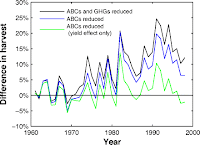
An article by Auffhammer M, Ramanathan V. and Jeffery V in December 26th, 2006 issue of Proceedings of the National Academy of Sciences (PNAS), USA suggests that atmospheric brown cloud (ABC) and green house gases (GHG) are responsible for reduction in rice harvest in India. Atmospheric brown cloud is a term coined by Ramanathan to describe aerosol layer with absorbing nature of particles. Many scientist argue that aerosols are counteracting the warming trend due to green house gases and can be used to mitigate warming trend by putting them in stratosphere. However in case of rice harvest in India both aerosols and GHGs act complementary to each other with net effect of reduction in rice production. Approach taken in this article is different in the sense that it is not about biogeophysical aspect. Rather it is a fusion of economical and general circulation models. Authors have used statistical approach to know how changes in rainfall or extreme temperatures affect area to be harveste...