Posts

Showing posts from January, 2007

Monitoring of Atmospheric Aerosols Using MISR

Image
NASA launched its first Earth Observing System satellite Terra in May 1999 with five different sensors onboard to monitor and study earth-atmosphere system. MISR is one of the instruments, which is primarily designed to study aerosols and clouds. More on MISR instrument is given in previous post by Harish in the same blog. Since the launch, MISR is providing good quality data of various aerosol properties over global ocean and land. Multi-angle capability of MISR enables retrieval of aerosol properties over both dark and bright targets, which is not available from other sensors such as MODIS . The most important parameter in aerosol research is aerosol optical thickness (AOT), which indirectly tells us columnar loading of aerosols in the earth-atmosphere system. Validation exercise shows that 67% time AOT are within ±0.05 or 20% of AEROENT AOT ( Kahn et al., 2005, Abdou et al., 2005, Christopher and Wang, 2004, Martonchik et al., 2004 and Jiang et al., 2006 ). Also, the accuracies ar...

Aerosol and Cloud Study using MISR

Image
Multi-angle Imaging SpectroRadiometer (MISR) is an instrument flown aboard terra satellite by NASA on August 1999. As its official web-site truly claims; no instrument like MISR flown before in the space. The unique feature of MISR is its nine cameras looking in nine different directions simultaneously. This affords us to view a given place on the earth from different angles and made it possible to estimate many physical parameters from space. Concept of the MISR is based on a fact that if directional dependence of the scattered light is studied carefully it can reveal many features about target. Sunlight falling on the earth is not scattered equally in all directions. Halos around the moon in the presence of cirrus clouds is one of such phenomena. Ability to view a given location from multiple angle has made it possible to observe many physical quantities for atmospheric aerosols and clouds which otherwise were not possible or difficult to observe from space such as single scattering...

Global Warming: Debate Continue

Global climate change is one the area to watch in 2007 as noted by Science magazine in an issue published on December 22, 2006. According to science ‘The case for human-induced warming will grow even more ironclad as the Intergovernmental Panel on Climate Change releases its report in February. Meanwhile, the International Polar Year, opening in March, will feature climate research on Earth's coldest climes. And the world is watching the U.S. Congress, which, under Democratic control, is expected to pass some sort of mandatory emission regime, and President George W. Bush, whose response will be sure to shape the debate’. But how general public think about global warming? Do they really understand it properly? A survey conducted by David Suzuki Foundation reveals it, ‘Simply put, most people don’t have a clue. The majority felt that global warming was a pretty important problem and they were concerned about it. But when pressed as to why it was a problem or what caused the proble...

Aerosols and green house gases responsible for reduction in rice harvest in India

Image
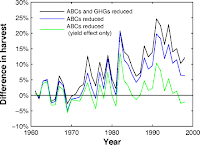
An article by Auffhammer M, Ramanathan V. and Jeffery V in December 26th, 2006 issue of Proceedings of the National Academy of Sciences (PNAS), USA suggests that atmospheric brown cloud (ABC) and green house gases (GHG) are responsible for reduction in rice harvest in India. Atmospheric brown cloud is a term coined by Ramanathan to describe aerosol layer with absorbing nature of particles. Many scientist argue that aerosols are counteracting the warming trend due to green house gases and can be used to mitigate warming trend by putting them in stratosphere. However in case of rice harvest in India both aerosols and GHGs act complementary to each other with net effect of reduction in rice production. Approach taken in this article is different in the sense that it is not about biogeophysical aspect. Rather it is a fusion of economical and general circulation models. Authors have used statistical approach to know how changes in rainfall or extreme temperatures affect area to be harveste...

One of Yoram's last contribution to aerosol science

'Wind reduction by aerosol particles' this is the title of Yoram Kaufman's one of the last published paper appeared in GRL during last month. Yoram was well-known scientist in aerosol community and called as 'father of satellite remote sensing of aerosols'. The present paper discusses the new dimension of aerosol research. Several research studies focusing impact of wind speed on aerosols are published but this is first time Jacobson along with Yoram talks about effects of aerosols on wind speed. Study shows that directly and indirectly aerosol particles can reduce wind speed by 8% locally, which is related to reduction in precipitation. Refer the published article for further findings of the research and detailed methodology used. Jacobson, M. Z., and Y. J. Kaufman (2006), Wind reduction by aerosol particles, Geophys. Res. Lett., 33, L24814, doi:10.1029/2006GL027838.